Summary
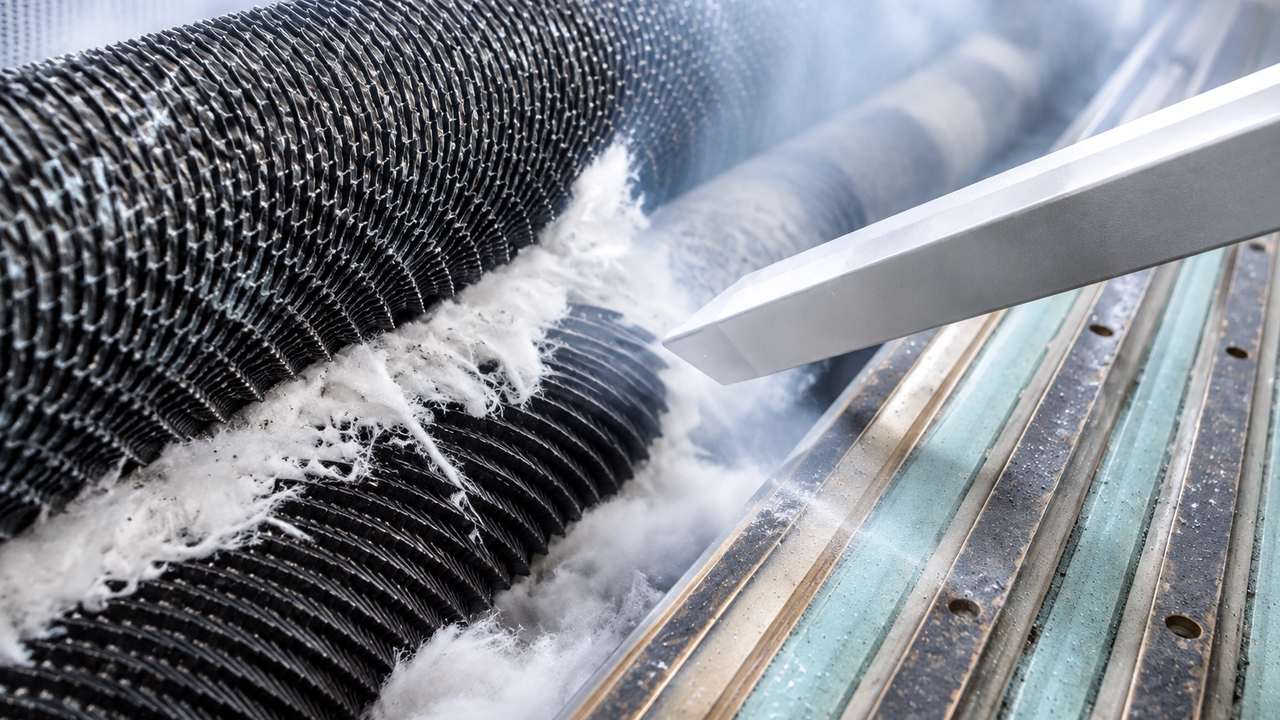
Cold Jet dry ice blasting cleans textile production equipment—rollers, looms, and stenter ovens—in-place without water, chemicals, or secondary waste. The non-abrasive, completely dry process removes fiber buildup, adhesives, and dye residue without damaging wire-wrapped rollers, cutting cleaning time up to 95% while protecting delicate equipment.
What is dry ice blasting used for in the textile industry?
Dry ice blasting is a non-abrasive, water-free cleaning method used by textile manufacturers, nonwoven producers, and technical fabric operations to clean production equipment in-place—carding machines, spinning frames, weaving looms, reeds and heddles, tenter and stenter frames, wire-wrapped and dye rollers, drying and curing ovens, and conveyor systems. Solid CO₂ sublimates to gas on impact, removing fiber buildup, fly, adhesives, latex, dyes, and hardened resins without water, chemicals, or secondary waste. Because it is non-abrasive, it cleans delicate wire-wrapped rollers and precision components without the surface damage that drives costly rewiring, and because it is completely dry, it safely cleans hot stenter ovens at operating temperature and protects electronic sensors and controls from moisture. Textile operations report cleaning-time reductions up to 95%, fewer contamination defects, and more first-quality runs. Cold Jet has more than 24,000 machines installed globally.
Fiber Buildup and Abrasive Cleaning Damage Equipment
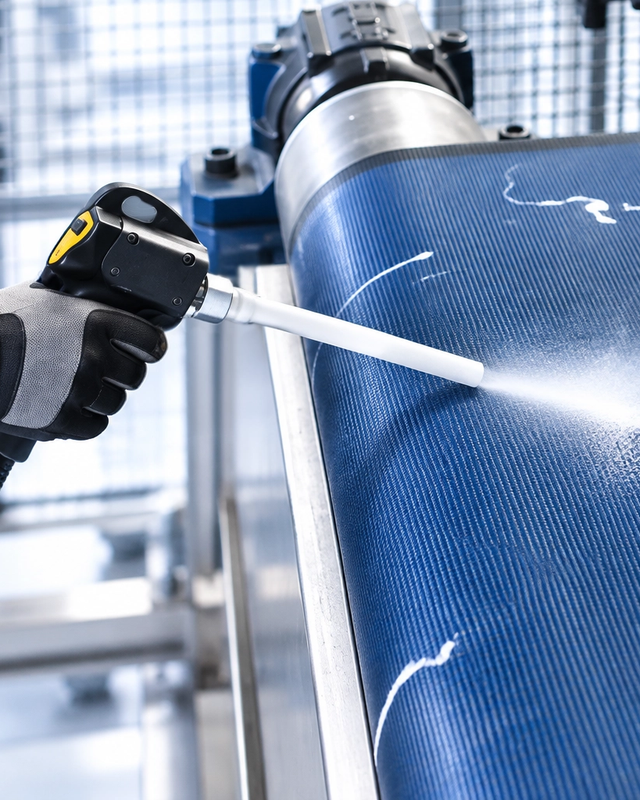
Textile equipment accumulates fiber fly, grease, adhesives, and dye buildup that causes contamination defects and B-grade fabric. Traditional cleaning—manual scraping, solvents like MEK, and pressure washing—is slow and damaging: abrasive methods harm wire-wrapped rollers (often $1,000 rewiring jobs), and water-based cleaning damages electronics and forces hot equipment offline.
Cold Jet dry ice blasting is non-abrasive and completely dry. It removes fiber buildup, adhesives, and resins in-place—cleaning wire-wrapped rollers with zero wear and stenter ovens at operating temperature. With no water or secondary waste, operations cut cleaning time up to 95% and run more first-quality goods.
Higher Quality
Fewer B-Grade Runs
No Shutdown
Clean During Breaks
Less Labor
One Operator Per Cleaning
Zero
Secondary Waste
Benefits of Dry Ice Blasting for Textile Manufacturing
Increase production capacity by reducing equipment downtime
Cold Jet dry ice blasting is non-abrasive, non-conductive, and water-free—effectively removing fiber buildup, adhesives, latex, dyes, and residue without damaging delicate rollers, wire-wrapped components, or electronic controls. Because dry ice sublimates on contact, it produces no secondary waste, leaves no moisture behind, and enables faster, more thorough cleaning than traditional methods like manual scraping, chemical solvents, and pressure washing—which damage surfaces, harm electronics, and require extended downtime.
 Reduce Downtime
Dramatic Time and Labor Savings
Dry ice blasting cleans textile equipment significantly faster than manual methods, reducing both cleaning time and labor requirements. A medical textile producer reduced equipment cleaning from 5 hours to just 15 minutes—a 95% reduction. Another manufacturer cut roller cleaning from 4 hours with 3 workers to 1 hour with a single operator—a 92% reduction in labor hours.
 Non-Abrasive
Protects Equipment and Eliminates Repair Costs
The non-abrasive process cleans delicate surfaces without causing damage, eliminating costly repairs from aggressive cleaning methods. One technical textile manufacturer eliminated $1,000 per roller in rewiring costs previously caused by abrasive cleaning. Cold Jet dry ice blasting cleaned their rollers in 30 minutes without any surface damage.
 Dry Process
No Secondary Waste or Moisture Damage
Dry ice sublimates into gas upon impact, leaving no water, chemicals, or blast media behind—protecting sensitive electronics and eliminating disposal costs. One nonwoven facility chose dry ice blasting specifically because it cleaned equipment in-place while keeping the environment completely dry, avoiding the moisture damage caused by pressure washing.
 Solvent-Free
Protects Workers From Chemical Exposure
Dry ice blasting eliminates the need for hazardous chemical solvents and reduces the physical strain of manual scraping. A precision converting facility eliminated hazardous MEK solvent entirely by switching to Cold Jet dry ice cleaning. The dry, non-toxic process protects workers from chemical exposure and repetitive strain injuries.
Dry Ice Blasting Applications for Textile Manufacturing
From fiber processing to finishing, textile manufacturing equipment accumulates fiber residue, adhesives, latex, dyes, and polymer buildup that must be removed to maintain quality and prevent unplanned downtime. Cold Jet dry ice blasting cleans equipment across all production stages—keeping lines running while protecting sensitive surfaces.
- Fiber Prep & Weaving
- Conveyance & Roller Maintenance
- Finishing, Coating & Stenter Ovens
Fiber Prep & Weaving
Fiber fly, wax, and grease on carding equipment and looms are the primary drivers of contamination-related substandard goods and B-grade fabric. In facilities operating high-volume weaving lines, manual cleaning with scrapers and solvents often fails to reach deep into reeds, heddles, and spinning frames, leaving behind residue that causes defects. Cold Jet dry ice blasting removes accumulated fly, dust, and grease in a fraction of the time required by hand. By achieving superior cleanliness without the use of water or “burn-off” methods, manufacturers can cut cleaning downtime by 50% while protecting the precision of their mechanical components.
Conveyance & Roller Maintenance
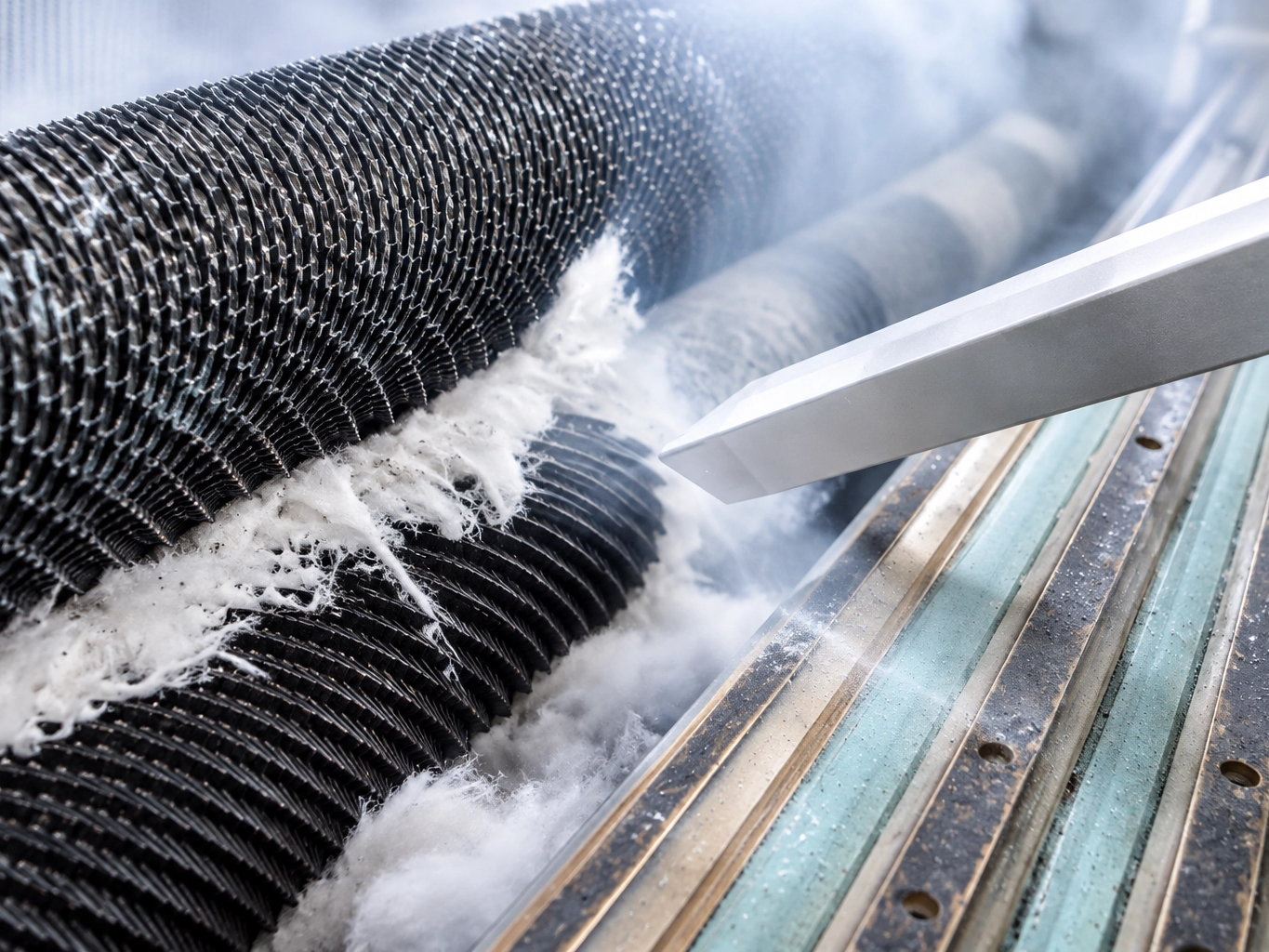
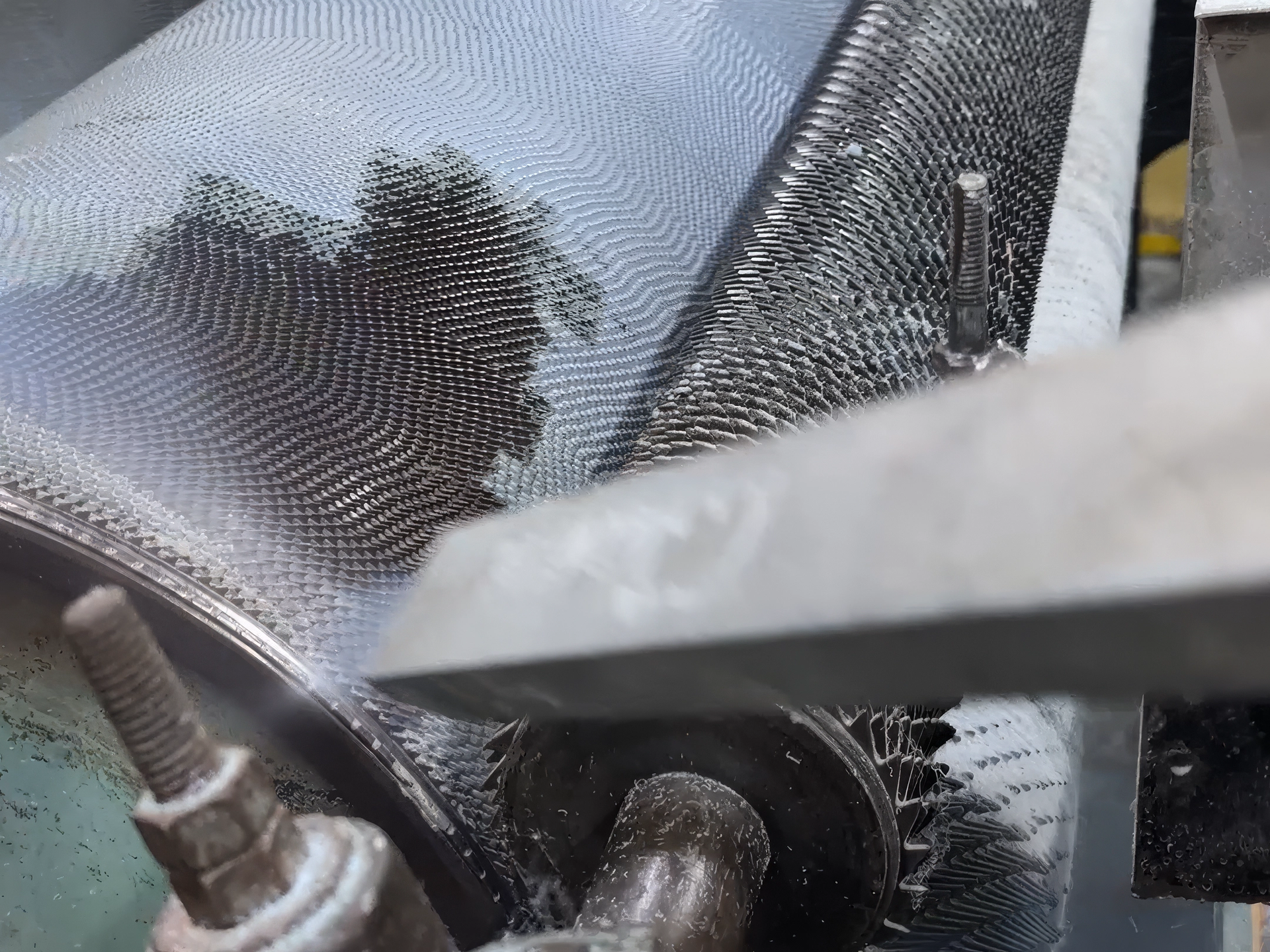
Wire-wrapped rollers, tenter chains, and Gillen clips are prone to latex and adhesive buildup that traditional abrasive methods struggle to remove without causing structural damage. For technical textile facilities, the cost of cleaning damage is high—often requiring $1,000 rewiring jobs per roller when wire-wraps are compromised by scrapers. Cold Jet dry ice blasting completes the cleaning of rollers and conveyor systems in as little as 30 minutes with zero surface wear. This efficiency enables a true preventive maintenance program.
Finishing, Coating & Stenter Ovens
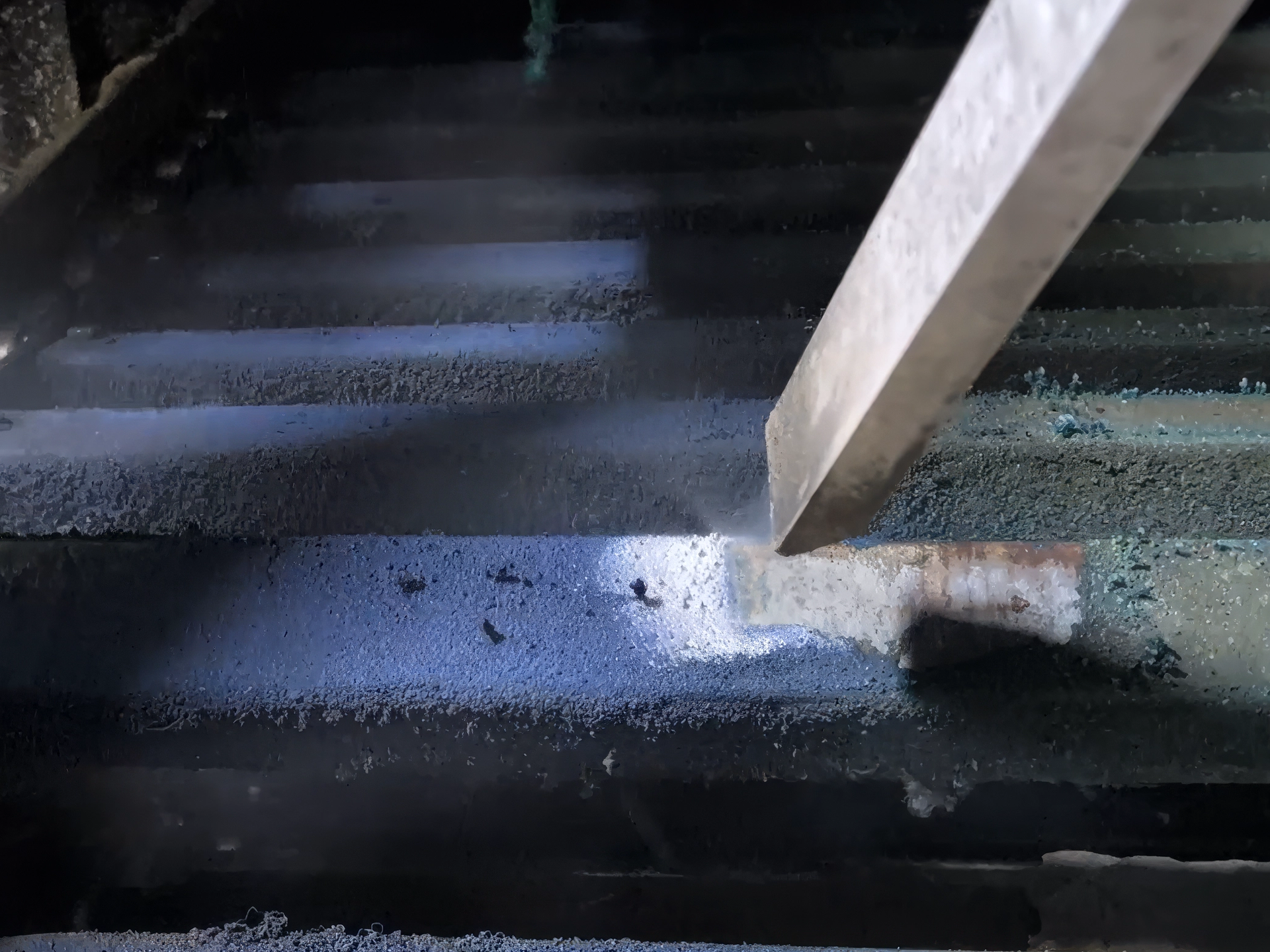
Finishing departments face the challenge of removing hardened resins, polymers, and dye buildup from stenter frames, drying ovens, and latex spraying units. Traditionally, cleaning these “hot zones” required a total production shutdown for cooldown and water-washing—a process that risks damaging sensitive electronic sensors and control panels. Cold Jet dry ice blasting removes over-sprayed material and carbonized residue at operating temperature without disassembly. This keeps the production environment completely dry and allows for thorough maintenance during scheduled breaks rather than extended shutdowns, ensuring that coating and thermal units remain at peak efficiency.
- Carding Machines
- Metallic Clothing
- Spinning Frames
- Weaving Looms
- Reeds, Heddles, & Bobbins
- Tenter/Stenter Frames & Chains
- Gillen/Tenter Clips
- Dye Rollers & Vats
- Drying & Curing Ovens
- Latex Spraying Equipment
- Glue & Adhesive Applicators
- Laminating Rollers
- Slitter & Doctor Blades
- Wire-Wrapped & Precision Rollers
- Conveyor Systems & Troughing
- Converting Machinery
What Do Textile Manufacturers Need for Dry Ice Cleaning?
Getting started with dry ice cleaning requires a few essential components:
Step 01
Dry Ice Blasting Machine
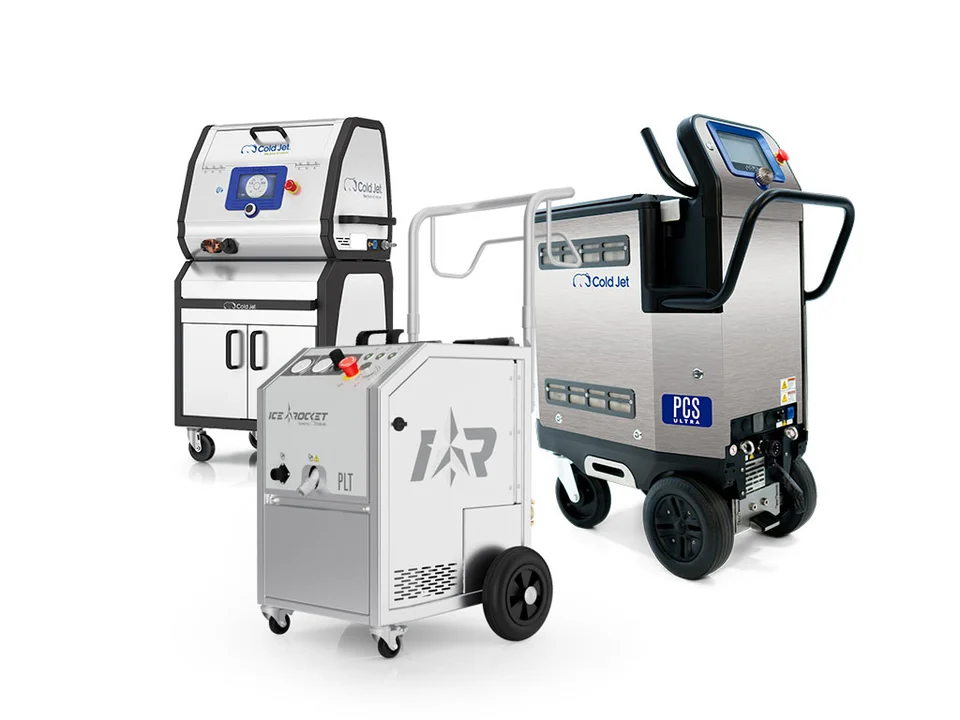
At the core of any dry ice cleaning operation is a dependable machine. Cold Jet dry ice blasters are built for the rigors of manufacturing—durable enough for daily use and versatile enough to handle both delicate components and stubborn contaminants. Every unit ships complete with blast hoses, an applicator, and a nozzle matched to your application.
- 01. Dry Ice Blasting Machine — At the core of any dry ice cleaning operation is a dependable machine. Cold Jet dry ice blasters are built for the rigors of manufacturing—durable enough for daily use and versatile enough to handle both delicate components and stubborn contaminants. Every unit ships complete with blast hoses, an applicator, and a nozzle matched to your application.
- 02. Compressed Air — Dry ice blasting requires a supply of clean, dry compressed air. Most textile facilities already have air systems in place that meet these requirements.
- 03. Dry Ice Supply — Consistent access to dry ice keeps your cleaning operations running smoothly. We can connect you with a local supplier and help determine the right order quantity. Once you’ve identified a supplier, establish a delivery schedule that aligns with your maintenance and production schedules.
- 04. Equipment and Operator Training — Proper training ensures your operators get the best results safely. Cold Jet provides hands-on instruction covering cleaning techniques, equipment operation, and safety protocols.
- 05. Personal Protective Equipment (PPE) — Operators should wear appropriate safety gear during blasting, including gloves, hearing protection, and eye protection.
How Dry Ice Blasting Compares to Alternatives
See how dry ice blasting stacks up against traditional cleaning methods across the criteria that matter most in textile manufacturing.
| Criteria | Dry Ice Blasting Best | Chemical Cleaning | Manual Cleaning | Sand Blasting | Laser Cleaning |
|---|---|---|---|---|---|
| Secondary Waste | None – sublimates to gas, no residue | High – spent solvents and wastewater | Moderate – scrapings, rags, solvent | High – spent abrasive media and dust | Low – vaporized residue needs extraction |
| Speed | Fast – up to 95% less cleaning time | Slow – soak, scrub, rinse | Slow – hand scraping is labor intensive | Slow – masking and cleanup add time | Slow – point-by-point on surfaces |
| Equipment Damage | None – non-abrasive, safe on rollers | Possible – residue on components | High – scraping mars wire-wraps | High – abrasive, damages rollers | Possible – heat can alter surfaces |
| Regulatory Compliance | Strong – water- and chemical-free | Limited – solvent (MEK) handling | Inconsistent – operator dependent | Limited – dust and containment rules | Limited – VOC exposure |
| Downtime | Minimal – clean in-place, no cooldown | High – soak and dry time | High – teardown and scrubbing | High – masking and cleanup | Moderate – slow per-surface setup |
| Environmental Impact | Low – no water or chemicals, reclaimed CO₂ | High – hazardous chemical disposal | Moderate – solvent and rag waste | High – abrasive dust and disposal | Moderate – generates VOC & energy intensive |
What Is the Best Dry Ice Blaster for Textile Manufacturing?
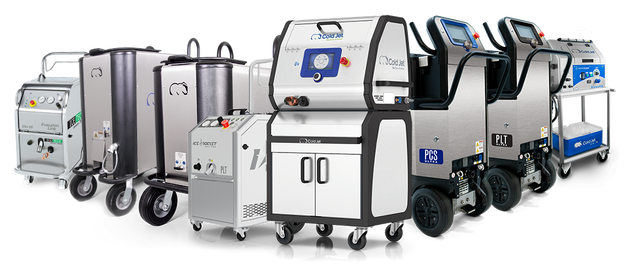
Textile manufacturers choose from Cold Jet’s full lineup of dry ice blasters to match their specific maintenance needs. Popular systems for textile manufacturing operations include:
Aero2 PCS Ultra
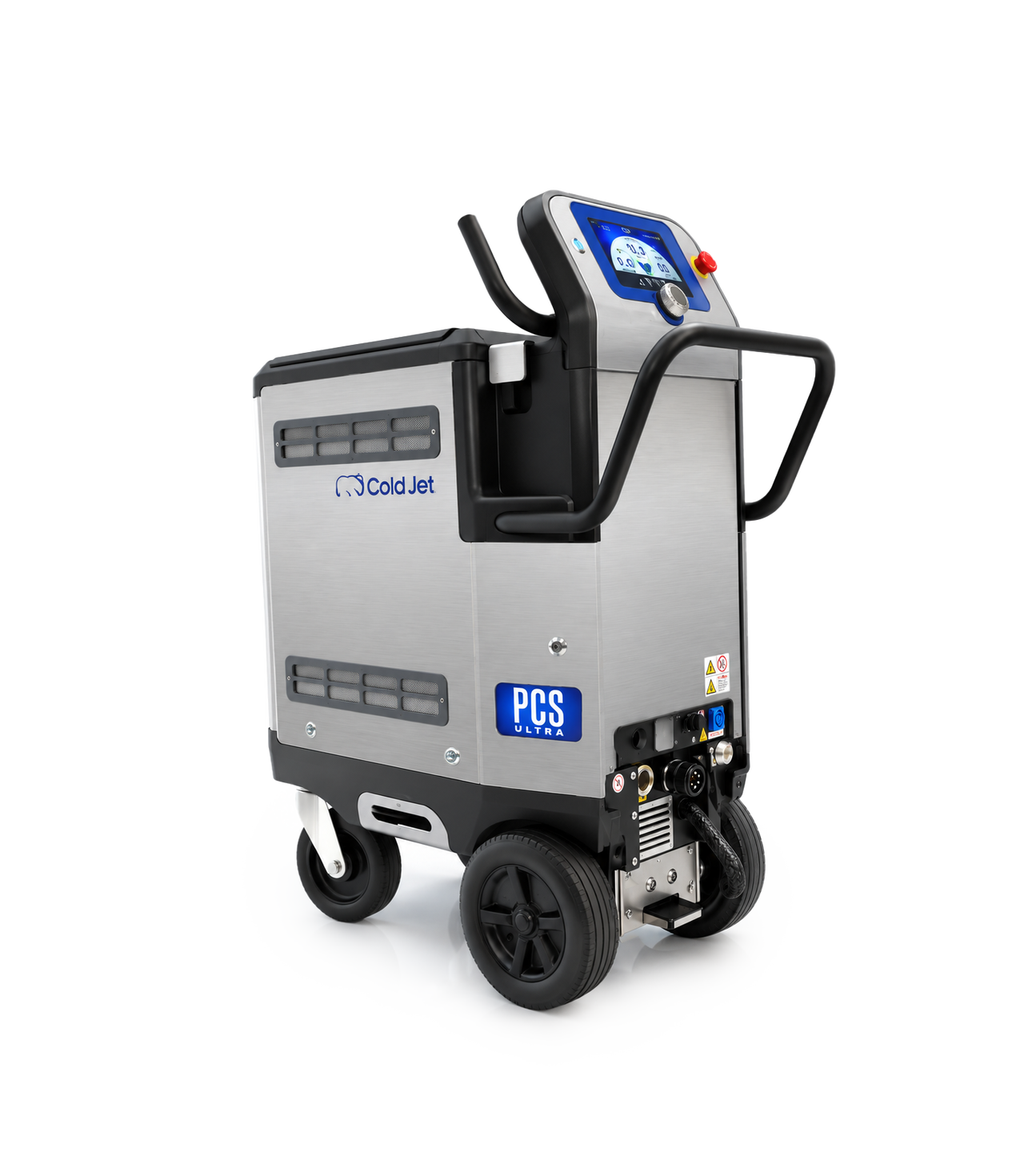
The Cold Jet Aero2® PCS® ULTRA is the most versatile dry ice blasting machine on the market. Powered by Cold Jet's patented Particle Control System™ (PCS), it cuts standard 3mm dry ice pellets into one of 28 selectable particle sizes — from 0.3mm to 3.0mm — giving operators precise, application-specific control over blast intensity and substrate impact. With a blast pressure range of 20–145 psi, it's built for both delicate precision work and sustained industrial cleaning. A 7" LCD touchscreen puts full control of blasting parameters at the operator's fingertips.
- Weight: 266 lb (120 kg)
- Nozzle Air Consumption: 12–100 cfm (0.33–2.83 m³/min)
- Blast Medium: Dry ice pellets
- Blast Pressure Range: 20–145 psi (1.4–10 bar)
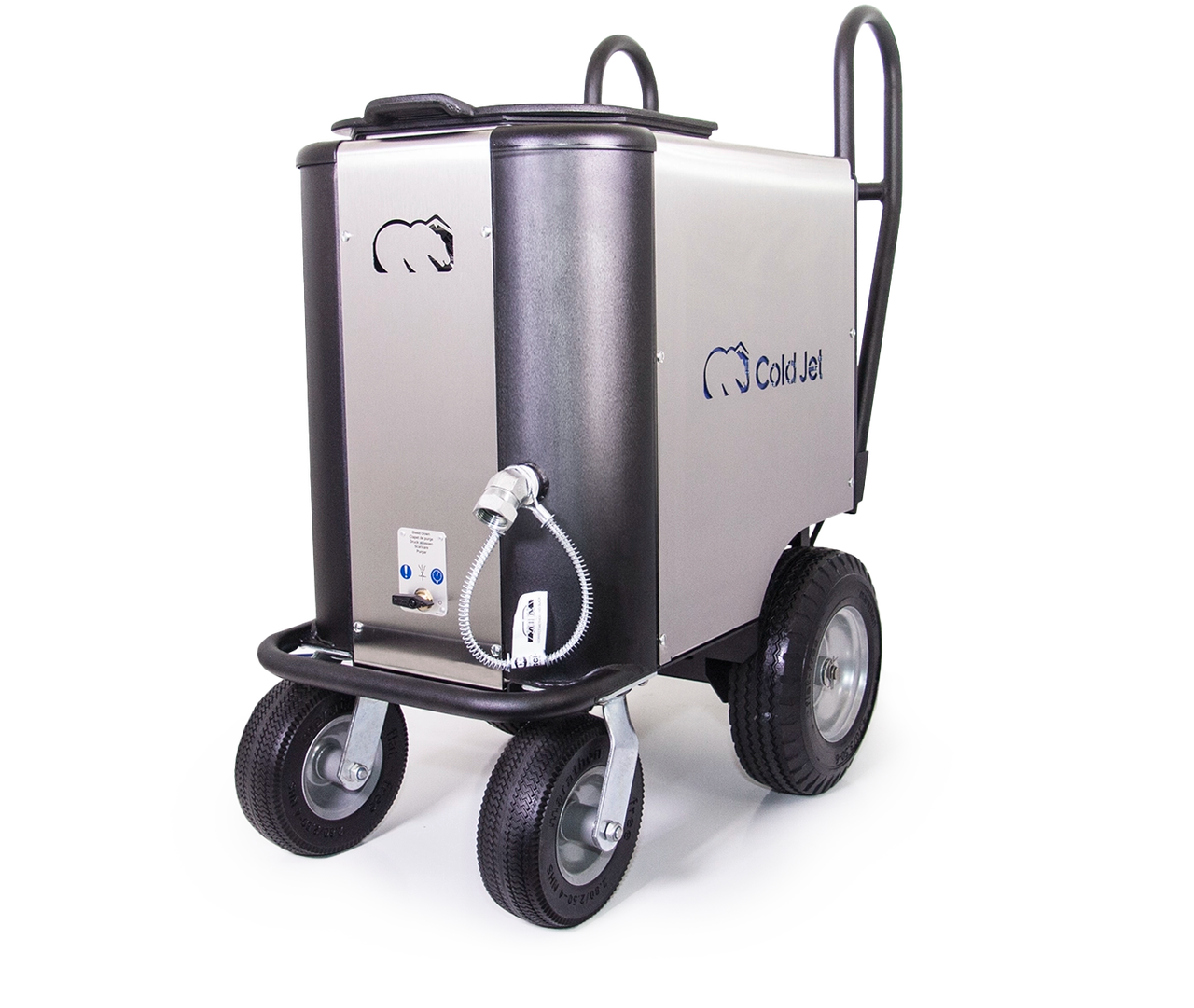
Aero 40FP
The Cold Jet Aero® 40FP is a mid-level, full-pressure dry ice blasting machine built for sustained industrial cleaning without chemicals, water, or secondary waste. Powered by Cold Jet's patented radial feeding system, it delivers pulse-free blasting at up to 4.5 lb/min feed rate across a pressure range of 20–250 psi. Holds up to 40 lb of 3mm dry ice pellets and consumes 50–165 CFM based on a standard operating pressure of 80 psi.
- Weight: 257 lb (117 kg)
- Nozzle Air Consumption: 50–165 cfm (1.4–4.7 m³/min)
- Blast Medium: Dry ice pellets
- Blast Pressure Range: 20–250 psi (1.4–17.2 bar)
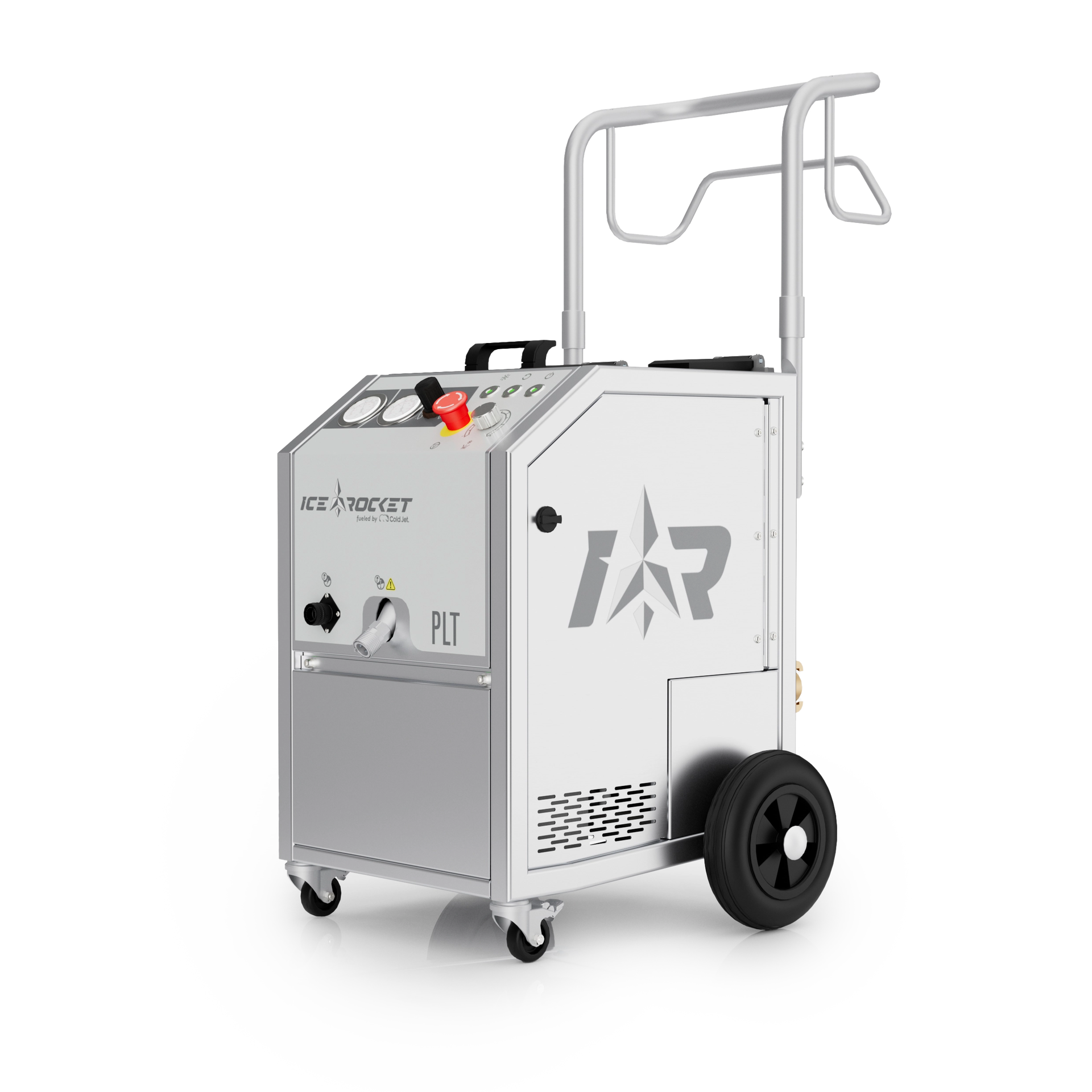
IceRocket PLT
The Cold Jet IceRocket PLT is a professional-grade, entry-level dry ice blasting machine engineered to outperform all other entry-level machines. Built on a stainless steel frame with an enhanced dosing disc for smooth, consistent pellet delivery, it delivers up to 1.5 lb/min feed rate and a full blast pressure range of 29–145 psi — all with minimal air requirements and a compact footprint. The IceRocket PLT is the most accessible path to professional dry ice blasting that Cold Jet offers.
- Weight: 106 lb (48 kg)
- Nozzle Air Consumption: 50 cfm (1.41 m³/min)
- Blast Medium: Dry ice pellets
- Blast Pressure Range: 29–145 psi (2–10 bar)
Which Dry Ice Blaster Fits Your Textile Operation?
Compare the Cold Jet blasters suited to textile production, so you can match each machine to lint, oil, and adhesive buildup on tenter frames, rollers, and nonwoven equipment.
| Specification | Aero2 PCS Ultra | Aero 40FP | IceRocket PLT |
|---|---|---|---|
| Particle Control | Leads on Particle Control Variable0.3mm to 3.0mm, 28 sizes | Standard3mm | Standard3mm |
| Controls | Leads on Controls Digital7" LCD, Recipes, IoT | Analog / Standard | Analog / Standard |
| Feeder Technology | Leads on Feeder Technology Two-Stage + Defrost Cycle | Advanced Radial Feeder | Horizontal Disk Dosing |
| Application Difficulty | Delicate to Aggressive | Moderate to Aggressive | Basic |
| Automation & Integration Capable | Leads on Automation & Integration Capable Yes | not published | not published |
| Dry Ice Capacity | Leads on Dry Ice Capacity 60 lb | 40 lb | 20 lb |
| |||||||||||||
Why Choose Cold Jet Machines for Textile Manufacturing?
When production uptime matters, you need cleaning equipment that won’t let you down. Cold Jet dry ice blasters are engineered for durability and built to deliver consistent performance—helping you get the most from your investment.
Proven Industry Experience
Cold Jet understands the unique cleaning challenges textile manufacturers face. From protecting delicate rollers to removing stubborn buildup, we’ve helped textile operations across the world solve their toughest maintenance problems.
Built to Last
Cold Jet dry ice blasters are engineered for demanding production environments. Our machines deliver unmatched reliability and outlast competitor models—performing consistently across multiple shifts, day after day.
Efficient Operation
Cold Jet provides maintenance support and comprehensive operator training to keep your team running at peak performance.
Expert Support
Cold Jet provides maintenance support and comprehensive operator training to keep teams running at peak performance.
Application Specific Accessories
Choose from a wide selection of applicators, blast hoses, and nozzles optimized for textile applications. Our team will help you configure the right setup for your specific cleaning needs.
Textile manufacturers around the world rely on Cold Jet
Trusted by textile manufacturers worldwide, Cold Jet has installed over 24,000 dry ice blasting machines.

Supporting Quality, Safety & Sustainability
Dry ice blasting helps textile manufacturers meet quality, worker-safety, and environmental goals without water, chemicals, or secondary waste.
Product Quality
Fiber fly, grease, and residue on carding equipment and looms cause contamination defects and B-grade fabric.
Non-abrasive dry ice cleaning removes buildup thoroughly without damage, reducing contamination-related defects and increasing first-quality runs.
Hazardous Solvent Elimination
Manual scraping and hazardous solvents like MEK expose workers to chemical hazards and repetitive strain.
Dry ice is non-toxic and eliminates hazardous solvents like MEK, protecting workers from chemical exposure and reducing physical strain.
Sustainability and Environmental Compliance
Pressure washing and chemical cleaning generate wastewater, spent media, and hazardous waste requiring disposal.
Chemical-free, water-free dry ice blasting eliminates wastewater and media disposal, supporting sustainability commitments and environmental compliance with reclaimed CO₂.